We are currently under construction on this site. Many more books will appear shortly.
The following site has some of the books not listed here but it is not exhaustive. We have more.
https://ellenreim.wixsite.com/website-2/books
Praise for Katherine Grace Bond
Jerry Austin
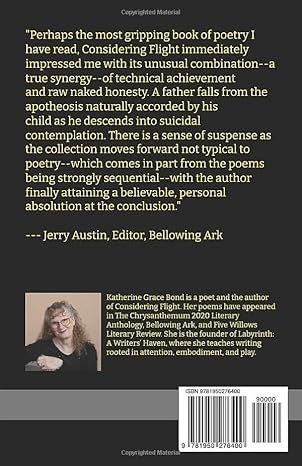
Perhaps the most gripping book of poetry I have read, Considering Flight immediately impressed me with its unusual combination–a true synergy–of technical achievement and raw naked honesty. A father falls from the apotheosis naturally accorded by his child as he descends into suicidal contemplation. There’s a sense of suspense as the collection moves forward not typical to poetry–which comes in part from the poems being strongly sequential–with the author finally attaining a believable, personal absolution at the conclusion.
~ Jerry Austin, Editor, Bellowing Ark
Carolyne Wright
This new edition—released twenty years after its first publication and eleven years after the passing of the father she loved and held in awe—was a turning point in the writing life of Katherine Grace Bond. Considering Flight establishes Bond as a poet at the height of her powers of perspective and insights into this brilliant but troubled man. This was the father of whom she writes that “Plutarch speaks to him in dreams”; but whose self-destructive rages leave his wife and children shaken and miserable, never knowing when he may indeed take “flying lessons / off the Aurora Bridge.” The suicidal threat is ever-present here, but the adolescent daughter, the author’s younger self, “wants him please to live.” Oedipal overtones of fear and fascination—not unlike those that Sylvia Plath felt toward her father (“my father’s chest rising and falling like God’s”)—are interwoven through these poems; but in this new edition, Bond as full-fledged poet claims the story as her own. She recognizes “the eyes of Seer in the dark / who pleads for just one breath of day,” and she asks “What alchemy can come of this?” The alchemy is this work of reconciliation with the feared beloved, in which the poet-daughter understands that “I could hold the thread of someone else’s life. . . and saving him save my own life as well.”
~ Carolyne Wright, Pablo Neruda and Blue Lynx Prizes, American Book Award, Pushcart Prize
Kelli Russell Agodon
With tenderness and courage, Katherine Grace Bond’s Considering Flight explores growing up in the shadow of her father’s mental illness. These poems are brave acts of witness, reminding us that telling the truth can be its own kind of rescue.
~ Kelli Russell Agodon, author of Accidental Devotions (Copper Canyon Press)
Gary Lilley
Katherine Grace Bond’s collection of poems, Considering Flight is a comet that has come ‘round again. Bond’s book of poems was first published twenty years ago. In the hoodoo culture of the American south where I grew up, they say benevolent spirits will show you signs of what is needed to bring you peace until you can see it yourself. Read Considering Flight from front cover to back. Bond writes a story about the mental illness of both a daughter and her father, poems about the fear of being “broken” and then saving her own life through facing it. Even through that fear, that honesty is what helps us bear up to it. It’s a soothing song.
~ Gary Lilley, author of Raven on the Moaners’ Bench and The Bushman’s Medicine Show.
Koon Woon
A man may be humbled by circumstances, but his spirit can remain indominable. Such a man was David Hotchkin (in memoriam), who was my parent surrogate, my mentor, and my editor. His erudition was phenomenal in reading, writing, and analysis. He’s at home in the “deconstruction” in literature, the analysis of luck and errors of great wars in the human sphere, and his experiences in post- World War II in Shanghai, China. Our lunch bill was split right down the middle, including the tip, and both of us invariably ordered the number two dinner with egg foo young at the Ying Hei restaurant in Seattle Chinatown, where the name indicates “The Happiness of Swallows,” which is the only invariant word in the English Chinese dictionary. He edited my poetry and examined my first book contract. He urged me to go back to school as he had gone back to law school after one year because of depression. In every way a fighter was he, and from him, I borrowed a great strength,
~ Koon Woon, poet, editor, publisher.
Katherine Grace Bond is a poet, novelist, and developmental editor. Her work explores family, history, and the rifts in our culture and ourselves. She is the author of seven books, including the YA novel The Summer of No Regrets (Sourcebooks), the children’s book The Legend of the Valentine (Zondervan), and three poetry collections. Her work has appeared most recently in Bellowing Ark, PNW Collaborative Magazine, and In Our Poetic Honor (Goldfish Press).
She has taught writing for more than three decades and has held residencies at Jack Straw Cultural Center and Camac Centre d’Art in Marnay-sur-Seine, France. She is the founder of Labyrinth: A Writers’ Haven, providing community, craft, and coaching to writers at all stages.
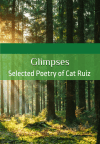
Cathy Ruiz demonstrates a poet’s sensitivity to sights, sounds, smells and events. She often evokes a vivid image for her readers by employing an unexpected phrase or word.
Whether it is the poignancy of My Father’s Study or the exasperated humour of I’m Thinking I will Throw My Smartphone into the Snake River, she persistently mines the perennial themes of mortality, nature, impermanence and consciousness. Click onto picture of Glimpses to purchase on Amazon.
Inquire at the top of this website if you are interested being a potential author of Goldfish Press Seattle. Send email to koonwoon@gmail.com

Goldfish Press Seattle
Magpie, a book of poems with illustrations by the very talented visual artist Jennifer Carrasco
Order on Amazon https://www.amazon.ca/Magpie-Jennifer-Carrasco/dp/1950276341


Mother and daughter heartfelt dialogue!
No Time Paperback – October 9, 2024
by Dean Brink (Author)
Brink’s book seems devoted to the dynamics of alienation and its ways of producing strange intimacies. Cold, confusing distance generates a fascinating aura of feeling with and feeling for the situations in these poems: as “Recent History” puts it, “Now we know each other through these inklings/ staining our thoughts with wonder.” The first poem, for example, establishes a speaker demanding care to avoid dangers in a walk. T he last line states as the purpose of such caution the ability to “enjoy the jaunt without a care.” Distance from one’s environment provides the key to a sense of freedom within it. “Marine Shadow: after Ashbery” proposes that “A sense of doom filled us with hope one mangrove at a time.” Brinks’ world seems to be a site in which herring “feed themselves to seals.” Compelling and disturbing accuracy demands efforts to come to terms with a totality that has no care for our efforts to construct it (Hegel be damned): trembling little fingers silencing cymbals sift melodies off shuffled notes never nameable, vertical, not to send you maybe a nudge—aperture loosening the long shot what we don’t know— closer then, though learning nothing, holding it. Boal said it and you decorated it never to get to it … I could not avoid the sense that in reading Brink we are engaging an Ashbery hardened by living in a new almost impenetrable America. There is the same ability to hear a language of feeling within or because of the poet’s distance, and, in the last and best poem in the volume, there is the unfolding of a prose mode of description that highlights the lyrical sensibility. That sensibility wants to embrace the affective energies in the states rendered as aspects of a struggle to take in the whole scene with a sanity-producing aura of amusement. More precisely, the poem is based on the problem of integrating past, present, and future by a speaker who ix cannot stop talking. Language proves marvelously effective at description, while being painfully ineffective at the work of making coherent wholes. Talking becomes the paradigm for being “here” and “not here” at the same time—a condition by which Brink seems to want to add a dramatic intensity to Ashbery’s mask of playful freedom. T hen the volume adds two brilliant diversions. “The Threepenny Space Opera” is a short sci-fi play based on Gay and Brecht but obsessed by what the body becomes in future conditions when medical science rules decision- making. The pain of identifying with the victims of this science, the beggars perhaps, becomes inseparable from the joy involved in identifying with the author’s inventiveness. Finally, there is a ten-minute play that begins in mockery of academic publishing and spreads to make ridiculous and yet necessary the voices that engage in shouting as their means of coping with domestic situations. This engagement comprises banal but ultimately painful discourse about the raising of children. This play ends with the cast singing their quarrels, not unlike what this reader felt by the conclusion of the book. —Charles Altieri
https://www.amazon.com/No-Time-Dean-Brink/dp/1950276309
These gripping books are available from Amazon.com

The Write-Age Writing Book
by Koon K Woon (Author)
This book may be described as a free-floating guide to evocative writing, based on the author’s award-winning poetics. You will hone your writing, prose or poetry, fiction or nonfiction to new heights. You will develop an acute sense of the feel of defamiliarization to bring the reader to literary landscapes that are both at once strange and familiar, but not ordinary. It is guaranteed that you will triple your literary skills in no time at all, as you make associative leaps to greater and greater heights of literary awareness and accomplishment. The author’s work has been used in the teaching of poetry and short fiction in some of our most outstanding universities. The author is in the ranks of internationally-anthologized poets.He holds nothing back from you.This is no formula-writing. Go forth to the frontiers as the author’s original work propels y

- Jennifer5.0 out of 5 stars A Beautiful Immersion into Nature, Fatherland, Sanctuary, and DesireReviewed in the United States on January 8, 2025Mary Anna’s poems are filled with an insatiable hunger…one for fatherland, for every burst of natural element…a longing of unresolved love, her unashamed walk on this planet. We feel her sanctuary and spirituality yet freedom to live and desire…and desire to be desired.
As we immerse in the poet’s words, it’s impossible not to contemplate our own transformations within the Church, among Mother Earth, and amidst our multicultural homes.
Contemplating sins of her past, Mary Anna asks,
“Do I dip fingers
in fonts now dry?
Prostrate myself
on the floor
near where an altar
once stood
and confessional doors
hang on rusty hinges?”
As time has catapulted forward, Mary Anna lives in “a season of no years,” perhaps questioning the purpose of regret and choosing to focus on what’s before her—like lover’s passion that doesn’t fade with age, and observing the simplicity of marigolds and coneflowers, as she pays special homage to Michigan waterways, flora, and fauna.
As I read through this collection of poetry, I felt myself going backwards more often than I did forward, re-reading and lingering on every line. In a way, I feel like this mimics Mary Anna’s closeness with her past and present–diligently taking the opportunity to closely reflect on each moment gifted to her.
Learn More
THE GOLDFISH CATALOG
Find Your Ne
AT THE TOWN CAFE
Cat Kigerl


LOVE, ISLAND
Sandra Noel
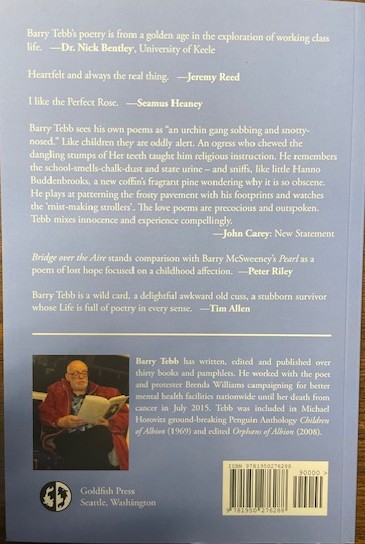

Brilliant book by scholar and worker Barry Tebb, psychoanalyst and teacher.